Posts

Showing posts with the label Marine Creature of the Month

Bruce and Chum's MCotM ~July 2021~
Image
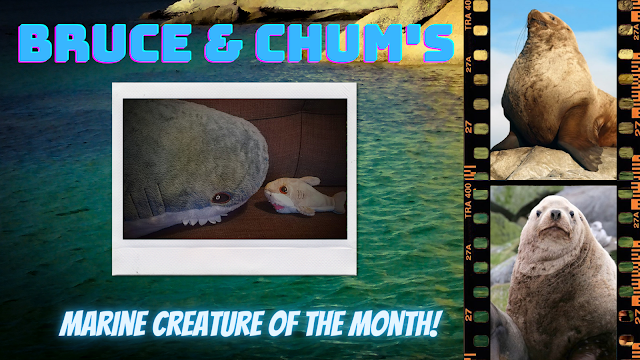
Bruce and Chum are back! They are taking over Marine Creature of the Month and making it their own. So, enough of my waffle already - I shall hand it over to my plushie friends. Name: Steller Sea Lion Location: Subarctic, from Alaska to Russia Habitat: Coastal waters, temperate climates Diet: Fish and cephalopods Conservation Status: Near Threatened (NT)     Bruce thinks...   These sea lions taste stellar! Get it?! They may be carnivores, themselves, but that won't stop me, other great whites, orcas, and sleeper sharks having a nibble. Chum says...   Stellar Sea Lions are very territorial. It's probably a good thing they like to live on isolated islands, the ladies can weigh anywhere between 240kg and 350kg! The males? They are 450kg to 1,120kg! For some context, I weigh about 10g... Ten Jawsome Facts The pups are born entirely black and weigh about 23kg. Their Latin name, Eumetopias jubatus , roughly translates to "maned one with the broad forehead". With a thick la...

Marine Creature of the Month - Around the World!

Image
  Name: Dugong Kingdom: Animalia Class: Mammalia Conservation Status: Vulnerable Location: Indian Ocean! The can be found off the coast of 40 countries in the Indo-Pacific area as they depend on seagrass meadows. These waters are warm and tropical, and they tend to be found in large protected bays around 10m (33ft) deep. If seagrass grows there, then it is likely dugongs will be found in the area. They have been known to travel to depths of 37m (121ft) to find that tasty grass. Size: Dugongs are classes as a medium sized marine mammal. They grow up to 3m (9.8ft) in length and would weigh about 420kg (926lbs) at this size. Appearance: Dugongs look a little like aquatic tapirs. They are blubbery and similar in shape to dolphins with an extendable snout. (Hence tapir.) Their mouth is very flexible for all their grazing needs, their upper lip is horseshoe shaped to maximise on their foraging endeavours. Much like other marine mammals, they have flippers and use their ...

Marine Creature of the Month Dec '20

Image
  Name: Wolf Eel Kingdom: Animalia Class: Actinopterygii Conservation Status: Stable, but not classified. Location: The wolf eel lives in rocky, shallow waters. They can be found in caves, reefs, and crevices in the Japan Sea and the Bering Sea up to North California. These areas are part of the North Pacific Ocean. Size: These bad boys can grow! Adults can measure up to 2.4m (that's nearly 8ft!) and they weigh a whopping 18kg. Appearance: Well, the wolf eel is certainly serving up a lewk. They possess the dappled, spotty look throughout their lives but start out with a brighter range of colours. Juveniles are orange with dark spots and they become greyer and darker colours as they age. As they are not true eels, they have large heads. Some of you may have noticed a few pouts in the selected pictures. Those are the males! The males have much more pronounced lips than the female wolf eel. All wolf eels have protruding teeth, which are very sharp and live inside an even stronger jaw...

Marine Creature of the Month Nov '20

Image
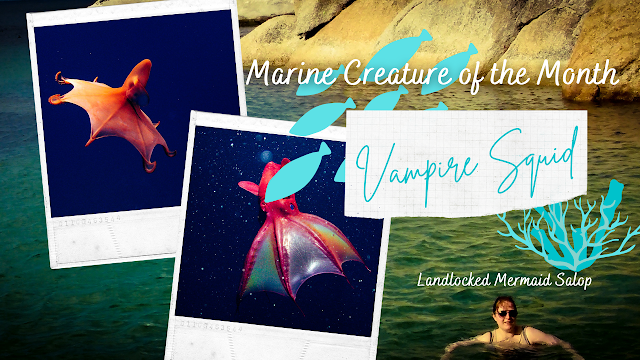
Name: Vampire Squid aka Vampyroteuthis infernalis aka Vampire Squid from Hell Kingdom: Animalia Class: Cephalopoda Conservation Status: Not Evaluated Location: Deep sea, from 600 to 900m (2-3,00ft), in the OMZ (oxygen minimum zone). Temperate and tropical oceans. Size: Vampire squid grow to be about 30cm in length, roughly 1 foot. Half of this is made of its gelatinous body, the other half its tentacles. Appearance: The vampire squid is dark and velvety in colour. Something that separates it from other cephalopods, the exception here being the Blanket Octopus, is the webbing between its tentacle. This gives our cute little MCotM a caped look! Each tentacle is lined with fleshy spines, known as cirri, and they only have suckers on the halves of their tentacles furthest from their bodies.  The vampire squid have large eyes which are blue or red in colour, depending on how the light catches them. These eyes are the largest eyes, proportionally, in the animal kingdom. Upon their m...

Marine Creature of the Month: Famous Fish Overview

Image
As Famous Fish has drawn to a natural close, I thought it would be fun to have a quick look at all the famous fishies we've looked at over the past year. Yeah, year! And to finish this theme in style, I thought we could do a vote to see who has been our favourite! Nemo the Clownfish Notable features: Stripey orange and white body. Live in anemone. Live in social hierarchies where ladies dominate. Threatened due to the popularity of Finding Nemo and climate change. Fun Fact:  When the dominant female is removed, the dominant male will change gender to fill her void. Free Willy the Orca Notable Features: Strident black and white patterns. Opportunistic hunters - they will eat anything that moves. The females live longer than the males. They are very intelligent creatures which do not thrive in captivity. Fun Fact: Despite being called "Killer Whales" they are actually dolphins. The moniker is believed to be an inversion of "Whale Killers" because they, you know, ...

Marine Creature of the Month July '20

Image
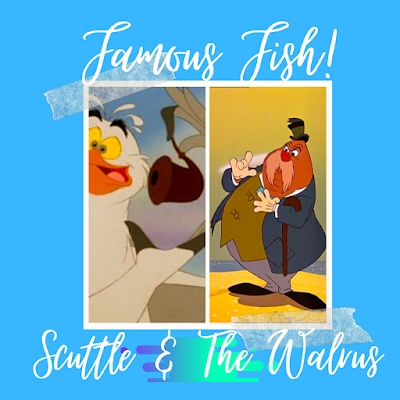
Marine Creature of the Month Famous Fish Made on Canva Scuttle and The Walrus We have a draw! For the first time ever on MCotM, a draw! I figure it is only fair that you get a post covering both of them. Instead of an in-depth profile on both, I am going to throw some fun facts about both of them your way. Scuttle the Seagull Kingdom: Animalia Class: Aves Conservation Status: Certain species are endangered (EN), like the herring gull. Picture from Varment Guard Seagulls are one of the few creatures which can drink sea water. They can drink salt water because of the glands above the eyes which flush salt out of their system, via holes in their bills. While Scuttle may not know the names for human objects, seagulls are actually very intelligent. They display learned behaviours like stamping their feet on the ground to mimic the rain and trick worms out of the ground. Not only do they show such intelligence but they pass the knowledge on. The oldest known gull is forty-nine years old. I...

Marine Creature of the Month June '20

Image
Marine Creature of the Month Famous Fish June Made on Canva Destiny the Whale Shark The votes are in! A landslide win for Destiny the whale shark! Kingdom: Animalia Class: Chondrichthyes Conservation Status: Endangered (EN) Picture from Scientific American WHAT IS DESTINY? Destiny is a whale shark. Whale sharks cause some confusion: are they a whale or shark? They are sharks with a whale's diet. Simple! Destiny belongs to the largest species of shark and one of three which do not adhere to a typical "shark diet". The other two are basking sharks and megamouth sharks, if you are interested. More on this later. They belong to the family carpet shark which included species such as wobbegongs, nurse sharks, and epaulette sharks. I could honestly get super distracted talking about all these sharks - but some were featured on Sharks @ 7 & 3/4 so go watch those videos! Whale sharks, on average, grow to be around 9.8m (32ft) but there has been a confirmed case of one bein...