Posts

Showing posts with the label ancient seas

Ancient Seas #12 - Fun Facts

Image
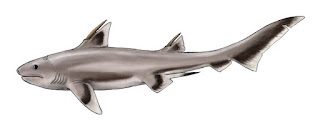
Ancient Seas Photo from Curiosity Helicoprion Helicoprion is an extinct shark, which lived 290 to 250 million years ago. This was during the Early Miocene to the Late Pliocene. They were found in oceans across the globe. It is believed they ate squid. "Helicoprion" means spiral saw. Can you guess why? Yep, because of that impressive jawline. They were discovered by Russian Andrzej P. Karpinski, in 1889. Only its teeth have fossilised, because soft tissues and cartilage do not fossilise. The spiral shape caused much confusion at the time of discovery! It is now widely agreed that they went in the shark's mouth, though it had been postulated that they were attached to the shark's fin! Although referred to as a "shark", helicoprion is more likely to have been a chimaera which was a cartilaginous fish. They grew up to 7.5m (25ft) and weighed 453.5kg (1,000lbs). The helicoprion survived a mass extinction which wiped out 90% of marine life a...
Ancient Seas #11

Image
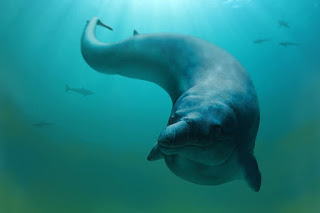
Ancient Seas Basilosaurus Photo from  Earth Archives Kingdom: Animalia Class: Mammalia Conservation Status: Extinct (EX) Era: Late Eocene (40-33.9 million years ago) WHAT WAS IT? The name would suggest that this creature was a dinosaur, an ancient lizard. But that was a mis-classification when first discovered in the US. Further fossil discoveries and study into the creature determined that this was in fact a mammal and a whale. It is even believed to be on the evolutionary line for modern dolphins. The Basilosaurus is one of the largest creatures to have existed in the time after the mass extinction event which wiped out the dinosaurs. It was 18-20m (59-66ft) long, which means it was not the largest sea creature to have ever lived but it is up there! It had a long, eel-like body and small hind limbs. Being only 35cm (11 inches) and made of three fused tarsals (or digits), these hind limbs did not have much function. With limited movement, it is pos...

Ancient Seas #10

Image
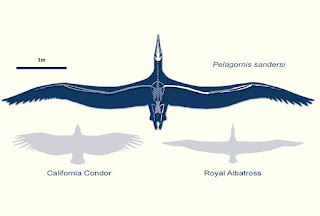
Ancient Seas Pelagornis Sandersi Photo from Sci-News Kingdom: Animalia Class: Aves Conservation Status: Extinct (EX) Era: Upper Oligocene (25 million years ago) WHAT WAS IT? If you hadn't guessed, it was a very big bird. The largest flying bird to have ever lived, in fact. (That we know of.) This toothed bird had an estimated wingspan between 6.4-7.4m (21-24ft), which is twice as wide as a royal albatross which soars in the skies above the seas today. Pelagornis Sandersi was identified as a new species in 2014 by Dr Daniel Ksepka, a paleontologist associated with Bruce Museum in Connecticut, despite being discovered back in 1983. Dr Ksepka was the scientist who extrapolated the wingspan, theorised its feather coat, and postulated that this bird could in fact fly - despite its size. Pelagornis means "pseudo-tooth"; this "toothed" bird actually had small spiny protrusions on its beak which functioned as teeth. They were not actua...

Ancient Seas #9

Image
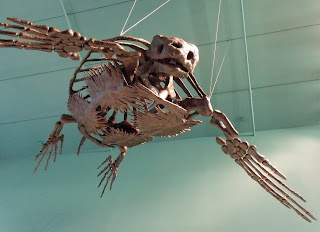
Ancient Seas Archelon Photo from Wikipedia Kingdom: Animalia Class: Reptiia Conservation Status: Extinct (EX) Era: Late Cretaceous WHAT WAS IT? Archelon was a large marine turtle, believed to be the largest ever documented sea turtle. The largest specimen, named Brigitta, was 4.5m (15ft) from head to toe; 4m (13ft) flipper to flipper; and weighed 2,200kg (4,900lbs). Instead of a hard shell, they had a leathery carapace with ridges up to 5cm (2inches) long. Its head was distinct with a narrow and elongated shape, and had horizontal nostrils on the top of its skull which is unusual in comparison to its modern counterparts. WHERE AND WHEN DID IT LIVE? The Late Cretaceous was 66-100 million years ago. During this time period, there was a large inland sea splitting North America into two land masses. This was called the Western Interior Seaway and its where the archelon lived. At its largest, this body of water was 700m (2,500ft) deep, 970km (600 miles) w...

Ancient Seas #8

Image
Ancient Seas Pteraspis Photo from Encyclopeadia Britannica Kingdom: Animalia  Class: Pteraspidomorphi Conservation Status: Extinct (EX) Era: Pragian epoch of Devonian Era, 398 - 416 million years ago WHAT WAS IT? The pteraspis was a heterostracan fish. This means it was a jawless vertebrate. It was a common during this era for fish to be jawless. The pteraspis was also a placoderm, which meant it was armoured. To summarise, this fish has a spine but no jaw, and is half armoured. Fish were weird 400 million years ago! However, it was one of the last species of both heterostracan and placoderm fish suggesting there was no longer a need for these evolutionary advantages. Both types of fish were extinct by the end of the Devonian Era. WHAT DID IT LOOK LIKE? Well, it wasn't the prettiest fish. Its front half was armour plated, which would have been used for protection against predation. It was streamlined and finless, but did have protrusions fro...

Ancient Seas #7

Image
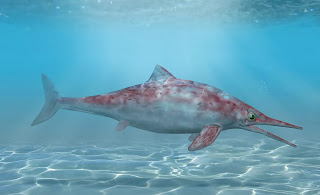
Ancient Seas Ichthyosaurus Photo from DK Find Out! Kingdom: Animalia Class: Reptilia Conservation Status: Extinct (EX) Era: Late Triassic - Early Jurassic WHAT WAS IT? Discovered in the early 19th century, Ichthyosaurus was a large marine reptile which belongs to the order of Ichythosaurs. From the early Triassic to late Cretaceous eras, there were at least fifty species of Ichythosaur roaming the ancient seas. It is believed they evolved from a land reptile which returned to the sea - much like with whales and dolphins - and came to look similar over the years through convergent evolution. The Ichthyosaurus is the type genus of the spieces. WHAT DID IT LOOK LIKE? This marine reptile looked rather similar to dolphins, it is believed. They had dorsal fins, flippers, and a large caudal fin. In comparison to the others of the species, Ichthyosaurus was around the average size for the genus - measuring at around 3.3m (10.8ft) - whereas other species foun...

Ancient Seas Overview

Image
Ancient Seas #1 Megalodon Photo from Sharkipedia The megalodon was probably the largest predator to have ever lived - we haven't found one bigger yet. It is larger than the whale shark. Their teeth were over twice the size of great white's teeth. Recent discoveries of megalodon nurseries have led scientists to believe they gave birth in shallow waters. Ancient Seas #2 Sarcosuchus Photo from IMDb Its name, Sarcosuchus, means fleshy crocodile. It was twelve feet longer than modern saltwater crocodile. Their home became the Sahara desert. Ancient Seas #3 Plesiosaurus   Photo from ThoughtCo It is postulated that they laid their eggs upon land like the sea turtle. Their teeth were designed to catch prey, not chew. They swallowed their prey whole. Their long necks were supported by 40 vertebrae. Ancient Seas #4 Hybodus Photo from ThoughtCo The hybodus shark species survived on the planet ten times longer than the av...

Ancient Seas #6

Image
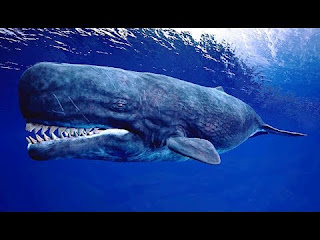
Liyvatan or Leviathan Melvelli Artistic Rendering from Scary Nature's YouTube Kingdom: Animalia Class: Mammalia Conservation Status: Extinct (EX) Found: Peru Era: Miocene Lived: 11-12 million years ago Diet: Smaller whales Weight: 57 tonnes* Size: 13.5 - 17.5m (44 - 57ft)* Habitat: Unknown *These are estimates, without living specimens or more remains it is nearly impossible to know. The leviathan melvelli or Livyatan was a toothed whale which lived around 12 million years ago during the Miocene era. It is the largest known extinct whale, which grew up to 17.5m (57ft). This is still smaller than the Blue Whale which lives today but it would have ruled the seas all those years ago, with evidence of it being a fierce hunter. Its remains were found in Peru, an area which would have been under the sea at the time making it rife with marine fossils. Colossal teeth had been found in 2008, but it wasn't until 2010 when more of this whale w...

Ancient Seas #5

Image
Dunkleosteus Dunkleosteus skull. Photo from Earth Touch Kingdom: Animalia Class: Placodermi Conservation Status: Extinct (EX) Found: Northern Hemisphere (based on fossil locations) Era: Late Devonian Lived: 358-382 million years ago Diet: Carnivorous, most likely other armoured fish Weight: 1 tonne* Size: 6m (19.7ft)* Habitat: Deep water *Based on the largest of the ten known species. Dunkleosteus were ancient, armoured fish which inhabited the Earth over 350 million years ago, first discovered in 1873. They belong to the Placoderm family, which derives its meaning from "plate" in Greek (plax-) and "derm" in reference to skin. They were fish with articulated armour plates around their heads and thorax. The ocean used to be full of these types of fish and the Dunkleosteus were among the biggest. Well, some of them were. There are ten known species of Dunkleosteus, the largest being D.terrelli . This was the one tonne...

Ancient Seas #4

Image
Hybodus Photo from New Dinosaurs Kingdom: Animalia Class: Choridricthyes Conservation Status: Extinct (EX) Found: Worldwide Era: Permian - Cretaceous Lived: 303.4 million - 66 million years ago Diet: Everything. Weight: 90.7kg (200lbs) Size: 2m (6.6ft) Habitat: Shallow seas The Hybodus is an ancient shark species which lived up until 66 million years ago. Unlike most sharks, these species were around for well over 200 million years. This is over ten times the average span of shark species as they are usually around between 10-20 million years. This was a successful shark, living through the Triassic, Jurassic and Cretaceous eras. Considering that it shared waters with plesiosaurs and mosasaurus who were both big predators; this is very impressive. It is not really known why they even went extinct. In appearance, Hybodus are your classic shark. They have the seven fins, the streamline body, the cartilage skeleton... the list goes on. They ...

Ancient Seas #3

Image
Plesiosaurus Photo from Wikipedia Kingdom: Animalia Class: Reptilia Conservation Status: Extinct (EX) (Unless you count Nessie.) Found: Worldwide, number of skeletons found in the UK Era: Jurassic Lived: 135 million years ago Diet: Piscivore/Carnivore Weight: 450kg (992lbs) Size: 3.5m (11ft) Habitat: Ocean The plesiosaurus is an icon marine dinosaur, as it is often how we depict the Loch Ness Monster. It has a long slender body, small head and wide flippers on its side. The term plesiosaur covers all dinosaurs with this combination of features, and they are closely related to pliosaurs (which is the dinosaur I was initially researching and getting confused about the spelling of, you can see how.) This dinosaur was discovered in 1823 by Mary Anning, a Victorian woman who collected fossils on British beaches. She is a fascinating woman who discovered a number of different dinosaur species and what a bezoar stone was. Fossilised poop if you are ...

Ancient Seas #2

Image
*cough* Rivers *cough* Sarcosuchus Photo: Max Thomas Kingdom: Animalia Class: Reptillia Conservation Status: Extinct (EX) Found: Africa (sometimes South America) Era: Cretaceous Lived : 112 million years ago Diet: Fish Weight: Up to 8 tonnes* Size: 11-12m (36-39ft)* Habitat: Tropical regions, freshwater rivers.  *Estimates The Sarcosuchus is a giant crocodylian which lived over 112 million years ago, during the Cretaceous era. It is a distant relative of the modern living crocodylians, but has no direct living relatives as they are technically a pholidosaur.  Fragments of this gargantuan "croc" were first found between 1946-1956 by French paleontologists. More complete speciemens were not found until the late 20th century. From the fragments, scientists were able to extrapolate the estimated 11-12m size of the Sarcosuchus, which is over twice the size of the largest modern crocodile. The initial fragments were from the skull and p...

Ancient Seas: Megalodon

Image
I got a request from someone I work with to do a post about Megalodon. So me being me, I thought, why not make a segment about it? There is so much more to our oceans than what inhabits it right now. There are literally billions of years to cover. I am only one mermaid, but I can do my bit. So welcome to the Ancient Seas segment! Ancient Seas MEGALODON Class: Chondrichthyes Status: Extinct (EX) Size: 60ft* Weight: 77 tons* Era: Early Miocene to end of Pliocene aka 23-2.6 million years ago Diet: Large prey; whales, seals, giant turtles Habitat: Warm waters; juveniles: coastal *Estimates as, without time travel, it is impossible to acutally measure and weigh a Megalodon. And who would want to, right? Me inside Megalodon jaws, South Africa Museum What exactly was Megalodon? Well, it was huge. And I mean huuuggggeeeee! (Yes, that many extra letters huge.) If you are a fan at all of the creature feature B-movie genre, then I'm sure you've se...